

This post compiles all of my favorite gouache gear in one place. Over the years I have tried dozens of palettes, different gouache brands, and accessories and have lots of insights to share.
Table of Contents
Watch the Video
This post may contain affiliate links. Using an affiliate link to purchase your items gives me a small commission at no extra cost to you. New Jacksons Art customers receive 10% discount on their first order.
What is Gouache?
If you are brand new to gouache, I have an extensive blog post about it here. It goes in depth about what makes gouache unique.
What is the best gouache for beginners? (Top 3 Tips)
Regardless of brand, these are my top 3 tips for a beginner looking to buy gouache:
- Do buy the best quality you can afford. This will vary person to person. I have done extensive research and comparisons and found that my favorite (out of 12 brands) is Winsor & Newton Professional Designer Gouache. And my favorite has changed a few times over the years and yours probably will too! I’ve tried the most expensive brands, and some of them are fabulous. But since I paint a LOT I always come back to the best quality per value: W&N.
- Don’t buy a big set of colors to start with. It’s better to start with a small selection and grow your collection over time. Trust me, I know those big sets with all the pretty colors are tempting, but I think it is more important to start with a selection of CORE colors and learn how to mix what you need. Prices vary drastically across brands and countries. But if you only need 6 tubes to get started, you might be able to afford a higher quality gouache. And each tube is going to last you a really long time because gouache is so highly pigmented.
- Do buy tubes. Avoid pans, tins or “jelly” cups. Tubes are air-tight, resealable and will safely last years.

What Colors to Buy as a Gouache Beginner
My favorite brand is Winsor & Newton Designer’s Gouache. It’s the highest quality, best performing gouache with a lower price that I can buy in the UK. This is based on my own techniques and preferences for consistency. My second favorite is Shinhan for the same reasons, and thirdly would probably be Holbein.
My core colors:
- Titanium White aka “permanent white” (BUY)
- Ultramarine (BUY)
- Cobalt Turquoise Light (BUY)
- Cadmium-free Lemon Yellow (BUY)
- Quinacridone Magenta (BUY)
- Winsor Red (BUY)
- Burnt Umber (BUY)
- Lamp Black (BUY)
Bonus colors:
- Helio Turquoise (BUY) by Schmincke is a very unique color and one of my all-time favorites. You could use any phthalo blue to get a similar effect but this specific color is my favorite.
- Buff Titanium (BUY) by Daniel Smith has become one of my favorites for quickly muting my colors. It’s especially great for any kind of rock or beach scene.
- Any green you like, but by now you should be able to mix every green under the sun. To be honest I don’t like premixed greens because it’s difficult to make them look natural in my painting.
Of course you can keep adding colors from there. But these are the basics to get started. From my list, you can mix almost every color you’ll need. With the add-ons that increases exponentially. Color is a very personal decision and only you know what you need.
Remember…you can do a LOT with only 3 colors!

How does color make a difference in my painting?
Each combination of primaries will create a unique look. Some create more vibrant mixes. Others are more muted colors. You can use this to your advantage by carefully selecting colors that help you create the desired mood or atmosphere of your scene.

That’s why it is important to play with your colors as soon as you get them. Try filling a whole page with mixes and see the huge variety of color you can create. Try combining different sets of 3 or 4 to see how that changes the overall color palette.

Gouache Fades in Sunlight
Imagine selling an original gouache painting, and three months later the buyer tells you their painting has turned brown, or the flowers in the garden you so carefully painted have disappeared completely! Some pigment will completely fade off the page in less than a year. If you are serious about the longevity of your art (you should be if you plan on selling your originals), don’t use colors that fade. Of course, if you just use it for sketches in a sketchbook, this won’t matter.
Tip: If you don’t feel like concerning yourself with this topic, as soon as you’re done with your painting, scan it or take a photo. That way if you can make prints if you want to sell it.
As artists, we live in a wonderful time because there is a lot of information about how fadeproof (or “lightfast”) our colors are. Many brands share the ‘Lightfast Rating’ on their tubes of paint, their brochures, or their websites. But are they accurate? Not always. Many people have been doing independent studies and discovering even some of the biggest brands have false claims. I do my own lightfast tests for the colors I own. I share my results on my gouache database.
Luckily, there are some excellent databases out there that share their independent studies about pigment. Handprint is considered the pigment-bible of the art world. Kim Crick has a great blog (mostly for watercolor) that keeps growing.
But nothing beats your own tests. Make two sets of swatches, label each one, and hang one set in the sunniest window of your home. Keep the other set of swatches in a dark drawer. After 6 months, compare them. Some pigments fade more when diluted or mixed with white. So if you really want to learn the most, tint each color with white too.
Example of my lightfast results:

You can see the blues and greens have faded slightly after 6 months.
Paint Consistency
Not only is pigment important, but the actual consistency of the paint will make a big difference in the experience.
Consistency: how wet or dry the paint is straight out of the tube. How it feels as it spreads across the paper. Often this has to do with what kind of binder was used.
Gouache is pigment mixed with gum arabic binder, just like watercolor. However it contains more pigment than watercolor, and the pigment is not ground as finely. The highest quality brands don’t add fillers, or if they do it’s necessary for opacity because some pigments are naturally transparent. Cheap student-grade brands add chalky fillers which make the color look cloudy or milky and less vibrant. Often times they use less pigment as well, so the paint is more transparent. High quality gouache is naturally creamy and opaque but still VERY vibrant.
Note: sometimes you open the cap and some clear liquid pours out. That clearish (sometimes yellowish) liquid is the binder which has separated from the pigment. It’s annoying but it happens. Some pigments tend to naturally separate from the binder while they sit in storage. To remedy that, I usually stick a toothpick in and stir…it gets a little messy but it’s important to mix it before painting.
My Favorite Gouache Palettes
I use a wide variety of palettes and kits for gouache. And I use them in different ways on different days. I like variety. You may find one of these suits your needs better.
Favorite Studio Setup: Stay-Wet Palettes
In the studio I often use a Stay-Wet palette. It uses a sponge & palette paper setup and keeps the gouache from drying out. This is helpful for saving my gouache & mixes between sessions.
Currently my favorite is the Redgrasse Palette V2. I am currently testing their new Studio XL Art palette which has a glass palette and so far loving it! (not affiliate links)


It comes with a sponge and palette paper. Everything you need to paint multiple sessions (works with gouache and acrylic).
The palette paper can be wiped down and reused multiple times. I tested it and was able to reuse the same piece of palette paper for 5 months.

But there are many brands, a popular one is the Daler Rowney Stay-Wet palette or the Masterson Sta-Wet Super Pro palette. You can keep another smaller palette or mixing tray inside one of these too.
Homemade “Stay Wet Palette”
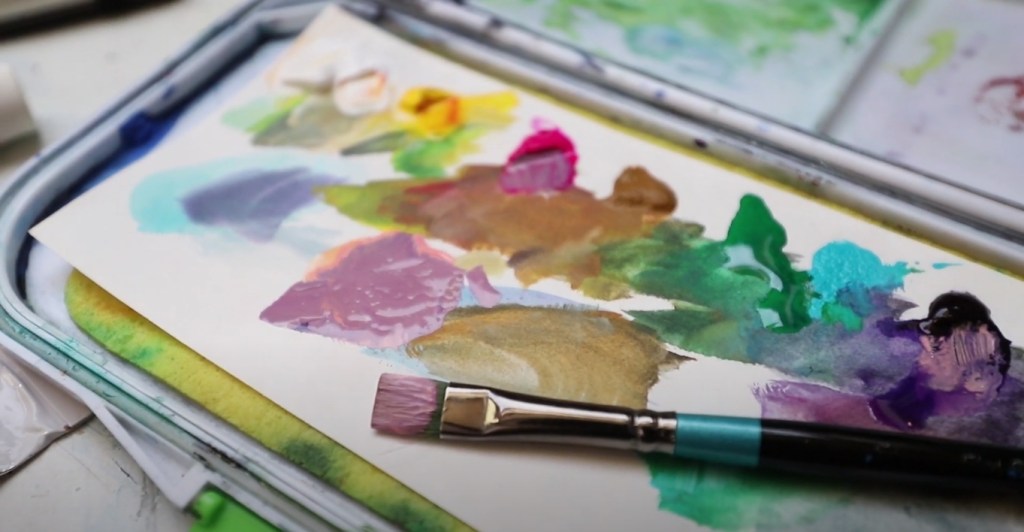
When I first started I used a homemade version of a “stay wet” palette. I bought thin kitchen sponges from the grocery store and cut them to fit in my watercolor palette. I added a piece of palette paper on top and this system helped keep the gouache moist. Then I would close my watercolor palette and it would keep the gouache moist for a few days.
Favorite Outdoor Kits: Dried Gouache Palette

My favorite plein air gouache palette is the Portable Painter Classic (BUY), which also happens to be my favorite travel watercolor kit, so I own a few of them. You can add “expansion” pans to fit even more colors. (BUY)
I have made several videos about using gouache in this way. Last year for “Plein-Airpril” I used it for 30 days in a row outside. This solidified by love for this palette. Watch the experience here.
I squeeze the gouache into the palette and close the lids. I let it dry for about a week before taking it outside. A word of caution: avoid using the really cheap student grade gouache in this way. When that stuff dries it often becomes rock hard and it is not opaque enough. But the professional high quality stuff is perfect for a dried gouache palette! You can read more about my experience here.
What colors are in my Portable Painter?

I use a wide variety of brands and change my colors often. The main reason is so I can experiment and get a feel for what brands work well in this “dried” format, and what colors I enjoy using outside. Over time, you will begin to gravitate towards the same few colors. If you notice you are never using one particular color, consider changing it out for something else.
- Shinhan Shadow Green Pale (BUY)
- W&N Cobalt Turquoise Light (BUY)
- M. Graham Cerulean Blue
- Schmincke Horadam Helio Turquoise (BUY)
- M. Graham Prussian Blue
- W&N Ultramarine Blue (BUY)
- Shinhan Shadow Green Pale (BUY)
- W&N Perm. Alizarin Crimson (BUY)
- Shinhan Primary Magenta (BUY)
- Daniel Smith Buff Titanium (BUY)
- W&N Titanium White, “permanent white” (BUY)
- Shinhan Lilac (BUY)
- W&N Lamp Black (BUY)
- Daniel Smith Burnt Umber (BUY)
- Daniel Smith Hansa Yellow Light (BUY)
- Schmincke Horadam Titanium Gold Ochre (BUY)
- Shinhan Naples Yellow (BUY)
Plastic Tray with Lid
I originally bought it for acrylic years ago to fit in my Guerrilla Painter 6×8 Thumbox. This is the 6×8 Guerrilla Backpacker™ Covered Palette Tray and I’ve realized it’s wonderful for gouache.

It’s lightweight plastic and has a lid that fits very snuggly. I use it both inside the studio and outside (mostly if I know I’ll have a picnic table or something to paint at). For a 2-day painting sessions it’s great for saving my gouache and mixes. Similar to the stay wet palettes, but it will dry out after a few days because it’s not perfectly air-tight. I probably use this palette about half the time nowadays.
Ceramic Mixing Tray
One of my more “luxurious” palettes is a ceramic mixing tray. Paint glides across the surface and can be removed so easily. It’s ideal for gouache. However since it’s heavy and breakable I only use it in the studio.
Travel Palette for Wet Gouache
This is the perfect travel palette if you need a lot of fresh gouache. Rather than carrying tubes, you can pour your colors into the wells and you’re good to go. It comes with a collapsible water dish and the lid opens up to become the mixing tray. With the silicone seal, the palette is air-tight and leak proof. (BUY)

I used to keep my gouache in one of these palettes almost permanently. It makes the gouache so accessible and ready to go at any time. I paint outside a lot, so having this step done and everything ready to go encourages me to do it. I even used this in the studio when I didn’t feel like setting up my other palette. Just open it and start painting. Close it when you’re done.
If you like to use gouache almost every day both inside and outside this is a great option. But if you only use gouache once in a while, it might not be the best option. If you leave it alone too long it could encourage mold growth. I have a whole video about cleaning it and avoiding mold.
Flat Mixing Trays
I also use a variety of flat sheets of plastic to mix on. They are literally just sheets of plastic from the hardware store. I have them in white, grey and clear. You can get “artist” ones from different companies like the New Wave “go anywhere” grey mixing tray (BUY) but they are usually much more expensive. I prefer the plastic sheets with a shiny coating, as it helps the paint glide over the surface and clean up is easy. Below is an example – my grey sheet.

My Favorite Gouache Brushes
I created a set of custom brushes with Craftamo to suit my needs. These brushes are ideal for gouache and allow me to create the textures I love and gently layer the gouache.

In general I recommend flat brushes. The main reason is because gouache requires a lot of control over how much water is in the brush. Flat brushes don’t hold as much water as the large round watercolor brushes. Although I sometimes use those too, they are a little trickier. So flat brushes give me perfect control over my water and paint. Plus I love how I can use them in a wide variety of ways to create various textures. See how I use different brushes.
Paper for Gouache
You can pretty much use any paper with gouache as long as it’s thick enough. Since it’s a wet medium I would recommend 90lb paper or heavier. My top 2 papers/sketchbooks for gouache are:
- Daler Rowney Aquafine (hot pressed / cold pressed). This is cellulose paper, more economical and performs great.
- Stillman & Birn Nova Beige 8×10 sketchbook (BUY). I also really enjoy the smaller version. This is my favorite sketchbook for gouache since I prefer to paint on a toned paper. The paper is thick enough for wet media and smooth enough for ink too.
Of course, most any watercolor paper will also work amazingly well with gouache. I often use it on my Arches and Baohong paper which have lots of texture and it creates a unique look.
Other Accessories
I use this large brush bucket (BUY) most of the time (in the studio) because it has three water sections. I can clean my brush off in each one depending on which colors I’m using, which helps lower the chance of cross-contaminating my colors. Plus, my water source is downstairs and I don’t want to constantly go down to replace it, so this bigger water bucket helps me stay focused.

When I’m outside, I usually use the water dish that comes with portable painter. That is the most compact setup and easy to avoid spilling.
However if you need a bit of extra water, this is a great option: Double Water Cup with Lid (BUY).

You’ll also want a spray bottle (BUY). I buy them at my local B&M as a multipack which saves money.
How to Seal a Gouache Painting
I use cold wax to seal my gouache paintings. It makes them waterproof. Otherwise, store them safely in an plastic box, archival box or frame them. (BUY) Watch how I use it here.

How to Store Gouache Tubes
For long-term storage, keep your tubes inside a sealed plastic bag – remove excess air. Make sure each cap is tightly shut (not crooked). Some brands are notorious for bad cap design that lets air slowly seep in unless they are closed perfectly. I had a few of my tubes harden because the caps weren’t on correctly.
How to Store Gouache Paintings
The surface of gouache can be fragile. Since the paint is not permanent you need to protect it from moisture forever after. Even if it’s sealed you can get marks or dents on it. Another problem is that if the surface gets buffed (rubbed by other surfaces) it will turn shiny. You can end up with splotches of shine in some spots. To avoid this, I recommend NOT stacking your sketchbooks or paintings. Keep them upright in a folder or on a bookshelf. Or get an archival storage box because it’s acid free and sturdy enough to protect the paintings. (BUY)

If you paint in sketchbooks, you can use tracing paper between your pages to avoid the paint pressing on the other side.
When selling gouache paintings, let your buyer know to avoid touching the surface and avoid getting it wet!
Gouache Videos You Might Enjoy
- Dry brush effect tutorial https://youtu.be/csBLpCUSnig
- Best sketchbooks https://youtu.be/UYUPXM-gjQ8
- Comparing 8 brands of PRO gouache https://youtu.be/BS5VPFDnHvo
- Comparing 3 popular student-grade gouache brands https://youtu.be/uFNvCdKMktg
- Using dried gouache for 30 days in a row (outside) https://youtu.be/GH7BBaoUBBs
- Using dried gouache in a Portable Painter https://youtu.be/Q8JPTjDQ7H8
- My jump into dried gouache https://youtu.be/6bTxFD29hAQ
- How to avoid mold in your wet palette https://youtu.be/3oCXKa6vFGg
- How to deep-clean your wet palette https://youtu.be/IcbKYL5WGgo
- Gouache Lightfast test results https://youtu.be/YCDYR3McULc Painting with a limited palette (my old faves) https://youtu.be/CM5KFePxHSE
- How I used my sponge/paper back in the day https://youtu.be/TbvlGwOe5nw
- How I used my paint box back in the day https://youtu.be/pJt6LTJ9iy0
More about Gouache
Want to learn more about gouache? Read this blog post: What is Gouache? Everything you Need to Know
Love everything you put forth. I think you ought to compile all these kinds of articles and SELL THEM…FOR THE HOUSE OR STUDIO FUND!! 🙂 N I WANTBOTH FOR YOU. Good project for Wolfie ????
HUGS!! Sue in FL
Good idea! Or something like “Scotland Lines” where it is just a book of lines for line and wash on watercolor paper but we do the wash. It could even come with a video showing a bit of footage in each location. Now that’s my kind of coloring book!
This is amazingly detailed. Thank you for sharing so much information! Will you be doing one for watercolor?